WAEC 2026 GOVERNMENT ANSWER
GOVERNMENT OBJ


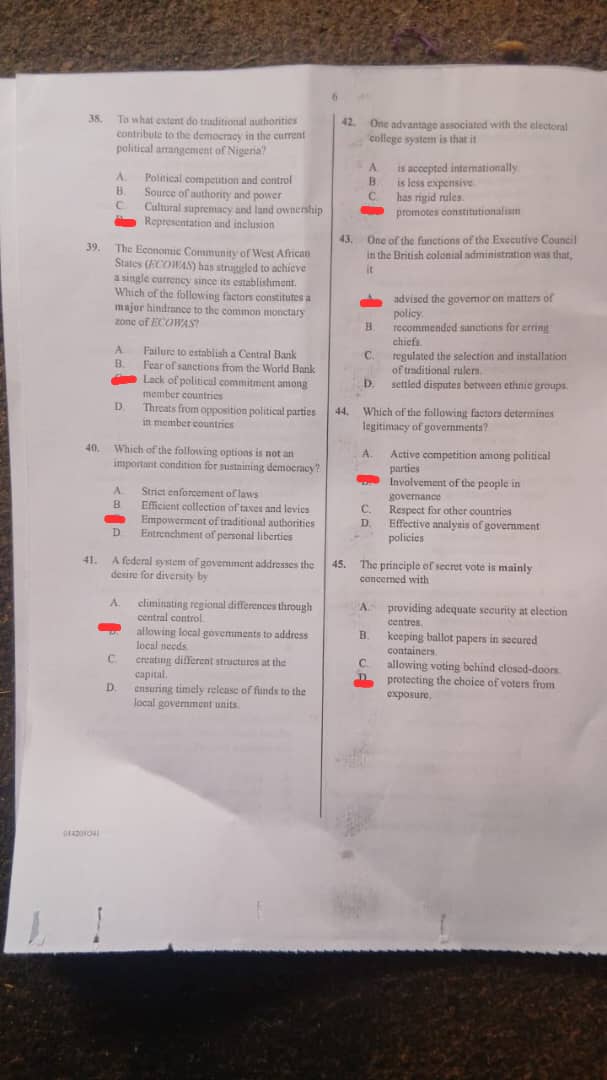

••••••••••••••••••••••••
(1a)
(PICK ANY THREE)
(i) Corruption in the judiciary
(ii) Delay in the administration of justice
(iii) Inadequate funding
(iv) Political interference
(v) Shortage of judges and court personnel
(vi) Poor court infrastructure
(vii) High cost of litigation
(viii) Lack of public confidence in the judiciary
(ix) Security challenges
(x) Poor record-keeping and case management systems.
(1b)
(PICK ANY FOUR)
(i) Judicial Accountability: Judges should be held accountable for their actions through disciplinary bodies and established ethical standards. Any judge found guilty of misconduct should be appropriately sanctioned. This helps to prevent abuse of judicial powers, promotes responsibility, and strengthens public confidence in the administration of justice.
(ii) Separation of Powers: The constitutional separation of powers among the executive, legislature, and judiciary should be strictly observed. Each arm of government should operate within its constitutional limits. This prevents the concentration of power in the judiciary and promotes effective checks and balances in governance.
(iii) Adherence to the Constitution:
Judges must interpret and apply laws in accordance with the provisions of the Constitution. They should avoid personal bias, favoritism, or arbitrary decisions. Respect for constitutional principles ensures that judicial authority remains subject to the law and protects citizens' fundamental rights.
(iv) Transparent Judicial Processes: Court proceedings and judgments should be conducted openly and clearly, except where confidentiality is legally required. Transparency promotes public trust in the judiciary, discourages corruption and abuse of power, and allows citizens to monitor the fairness of judicial decisions.
(v) Effective Judicial Review and Appeals: A strong appellate system should exist to review decisions made by lower courts. This enables errors to be corrected and prevents judges from exercising unchecked authority. It also promotes consistency, fairness, and accountability within the judicial system.
(vi) Merit-Based Appointment of Judges: Judges should be appointed based on competence, integrity, experience, and professional qualifications rather than political influence or favoritism. Merit-based appointments help to ensure judicial independence, improve the quality of judgments, and reduce the risk of judicial autocracy.
(vii) Continuous Legal Education: Judicial officers should receive regular training and professional development to keep them informed about new laws, legal principles, and ethical standards. This improves their competence, reduces the likelihood of arbitrary decisions, and enhances the quality of justice delivery.
(viii) Independent Oversight Bodies: Independent bodies such as the National Judicial Council should effectively monitor judicial conduct and performance. Such oversight helps to detect misconduct, enforce discipline, and ensure that judges exercise their powers within constitutional and legal limits.
=============================
(2a)
(PICK ANY ONE)
(i) Pressure Group: A pressure group is an organized association of individuals who share common interests and seek to influence government policies, decisions, and actions in favour of their members. Unlike political parties, they do not contest elections or aim to form a government.
(ii) Public Opinion: Public opinion refers to the collective views, attitudes, beliefs, and judgments expressed by a large number of citizens on matters of public concern. It influences government decisions and policies because leaders often consider the wishes and reactions of the people.
OR
(i) Pressure Group: A pressure group is a voluntary organization of people with similar interests that seeks to influence government policies and decisions in its favour. It does not seek political office but uses various means such as lobbying, petitions, and advocacy to achieve its objectives.
(ii) Public Opinion: Public opinion is the general opinion or viewpoint of the majority of people in a society regarding political, social, or economic issues. It serves as an important guide to government in formulating policies and making decisions that reflect the wishes of the people.
(2b)
(PICK ANY FOUR)
(i) Promotion of Citizens' Interests: Pressure groups represent and defend the interests of their members by communicating their needs, demands, and grievances to government authorities. Through this role, they ensure that the concerns of different sections of society receive attention in policy-making.
(ii) Political Education and Awareness: Pressure groups educate citizens on political issues, government policies, rights, and responsibilities. By organizing campaigns, seminars, and public discussions, they increase political consciousness and encourage people to participate actively in democratic governance.
(iii) Influence on Government Policies: Pressure groups lobby government officials, legislators, and policymakers to adopt laws and policies that favour their interests. Through persuasion, advocacy, and consultation, they contribute to policy formulation and help shape government decisions.
(iv) Check on Government Excesses: Pressure groups monitor government actions and expose cases of corruption, abuse of power, and injustice. By criticizing unpopular policies and demanding accountability, they help prevent arbitrary rule and strengthen democratic governance in society.
(v) Encouragement of Public Participation: Pressure groups mobilize citizens to engage in political activities such as elections, public debates, protests, and consultations. This participation strengthens democracy by ensuring that government remains responsive to the needs and aspirations of the people.
(vi) Protection of Human Rights: Pressure groups advocate for the protection of fundamental human rights and freedoms. They campaign against discrimination, oppression, and injustice, while ensuring that government actions comply with constitutional provisions and internationally accepted democratic principles.
============================
(3ai)
(PICK ANY ONE)
A free election is one in which voters are allowed to make their choices without intimidation, coercion, bribery, threats, or undue influence. Citizens have the freedom to vote for candidates of their choice, campaign freely, express political opinions, and participate in the electoral process without fear.
OR
A free election is an election in which every eligible citizen has the unrestricted right to vote and contest for public office without pressure from government officials, political parties, or any other group. Voters are free to make political choices according to their conscience and preferences.
(3aii)
(PICK ANY ONE)
A fair election is one in which the electoral process is conducted honestly, impartially, and transparently. All contestants are given equal opportunities to campaign and compete, while votes are accurately counted and results are declared without manipulation, thereby reflecting the genuine wishes of the electorate.
OR
A fair election is one conducted according to established electoral laws and regulations, with equal treatment given to all political parties and candidates. The electoral process must be transparent, impartial, and free from fraud, manipulation, or bias, ensuring that election results truly reflect the will of the people.
(3b)
(PICK ANY FOUR)
(i) Proper Voter Registration: INEC should ensure that voter registration is conducted efficiently and transparently. The use of modern technology can help eliminate multiple registrations and fake voters. An accurate voters' register enhances the credibility of elections and ensures that only eligible citizens participate in voting.
(ii) Use of Electoral Technology: INEC should continue to adopt technologies such as biometric voter accreditation and electronic transmission of results. These technologies help reduce electoral fraud, prevent impersonation, and improve the accuracy and transparency of the electoral process.
(iii) Voter Education and Awareness: INEC should intensify voter education programmes to enlighten citizens on their electoral rights and responsibilities. Educated voters are more likely to participate actively, reject electoral malpractice, and contribute positively to the conduct of credible elections.
(iv) Training of Electoral Officials: Electoral officials should receive adequate training before elections. Properly trained officials are better equipped to handle election materials, enforce electoral guidelines, and manage polling units effectively, thereby reducing errors and irregularities during elections.
(v) Strict Enforcement of Electoral Laws: INEC should work closely with security agencies and relevant institutions to ensure strict compliance with electoral laws. Individuals involved in vote-buying, ballot snatching, or other electoral offences should be investigated and punished to deter future violations.
(vi) Transparency in Result Management: Election results should be collated and announced in a transparent manner. INEC should ensure that results from polling units are properly documented and made accessible to stakeholders, reducing suspicion and increasing public confidence in the outcome.
(vii) Independence and Neutrality: INEC should maintain its independence from political interference and treat all political parties equally. An impartial electoral body is more likely to gain public trust and conduct elections that are accepted as credible by contestants and voters.
(viii) Adequate Security During Elections: INEC should collaborate with security agencies to provide adequate protection for voters, electoral officials, and election materials. A secure electoral environment reduces violence, intimidation, and disruption, enabling citizens to vote freely and confidently.
=============================
(4a)
(PICK ANY THREE)
(i) Implementation of Government Policies
(ii) Advising the Government
(iii) Maintenance of Government Records
(iv) Provision of Essential Public Services
(v) Revenue Collection and Financial Administration
(vi) Preparation of Government Budget
(vii) Maintenance of Law and Order
(4b)
(PICK ANY FOUR)
(i) Proper Record Keeping: The Civil Service maintains accurate records of government activities, expenditures, and decisions. These records make it possible to monitor official actions, verify transactions, and provide evidence when necessary, thereby ensuring transparency and reducing opportunities for corruption and mismanagement.
(ii) Financial Control and Auditing: Civil servants ensure that public funds are spent according to approved budgets and financial regulations. Through auditing and financial monitoring, they help detect irregularities, prevent embezzlement, and ensure that government resources are used for authorized purposes only.
(iii) Compliance with Rules and Regulations: The Civil Service operates according to established laws, procedures, and regulations. By insisting on adherence to official guidelines in government operations, it minimizes arbitrary actions, promotes discipline among public officials, and strengthens accountability in administration.
(iv) Preparation of Reports: Civil servants regularly prepare and submit reports on government programmes and activities. These reports enable supervising authorities to assess performance, identify shortcomings, and ensure that public officials are held responsible for their actions and decisions.
(v) Monitoring and Supervision of Government Activities: The Civil Service supervises the implementation of government policies and programmes through its various ministries and departments. Effective monitoring helps ensure that officials perform their duties properly and remain answerable for their actions and responsibilities.
(vi) Provision of Information to Government: Civil servants provide accurate and timely information required for decision-making and evaluation. This enables government authorities to assess the performance of agencies and officials, thereby promoting transparency, responsibility, and accountability in public administration.
(vii) Enforcement of Public Service Ethics: The Civil Service promotes accountability by enforcing codes of conduct and ethical standards among public servants. Officials who violate established rules may face disciplinary measures, which helps to encourage integrity, honesty, and responsibility in the discharge of duties.
(viii) Assistance to Oversight Bodies: The Civil Service cooperates with institutions such as audit departments, anti-corruption agencies, and legislative committees. By providing necessary documents and information, it facilitates investigations and reviews that help ensure accountability in the public sector.
============================
(5a)
(PICK ANY THREE)
(i) To provide essential services.
(ii) To promote economic development.
(iii) To control strategic industries.
(iv) To prevent monopoly.
(v) To generate revenue for the government.
(vi) To provide employment opportunities.
(vii) To ensure equitable distribution of services.
(viii) To correct market failures.
(ix) To promote national interest.
(x) To encourage industrial development.
(5b)
(PICK ANY FOUR)
(i) Profit-Oriented Management: Commercialization makes public corporations work towards making profit. This encourages management to avoid waste, increase output, and make proper use of available resources so that the organization can generate enough income and operate successfully.
(ii) Improved Accountability: Commercialization makes managers and workers more responsible for their actions and performance. They are expected to give proper accounts of how resources are used, which helps to reduce corruption and improve efficiency in the organization.
(iii) Reduction of Government Dependence: Commercialization reduces the dependence of public corporations on government funding. As a result, they are encouraged to generate their own revenue, spend money wisely, and manage their resources more effectively.
(iv) Increased Operational Efficiency: Commercialization encourages public corporations to adopt better methods of management and operation. This helps to increase productivity, reduce waste, and improve the quality of services provided to the public.
(v) Enhanced Competition: Commercialization exposes public corporations to competition from private businesses. This motivates them to improve their services, reduce costs, and satisfy customers in order to remain relevant and attract more patronage.
(vi) Better Staff Motivation: Commercialized corporations can reward hardworking employees through incentives and promotions. This encourages workers to be more dedicated, productive, and committed to achieving the goals of the organization.
(vii) Faster Decision-Making: Commercialization gives managers more freedom to make decisions without unnecessary delays. This reduces bureaucracy and enables the corporation to respond quickly to challenges and opportunities.
(viii) Improved Service Delivery: Since commercialized corporations depend on customers for income, they are encouraged to provide efficient, reliable, and high-quality services. This helps to improve customer satisfaction and increase public confidence in their operations.
============================
(6)
(PICK ANY FIVE)
(i) The Oba: The Oba was the supreme traditional ruler, symbol of authority, and custodian of customs. He supervised governance, maintained order, and represented the kingdom. In modern Nigeria, this resembles constitutional heads such as presidents and governors who provide leadership, unity, cultural identity, and ceremonial authority within the political system.
(ii) The Oyomesi: The Oyomesi was a council of seven kingmakers who advised the Alaafin and checked his powers. They could compel him to abdicate if he ruled unjustly. This resembles Nigeria’s legislature, which performs oversight, approves policies, and can impeach leaders who abuse authority or violate constitutional expectations.
(iii) The Ogboni Society: The Ogboni was a powerful religious?judicial body that upheld justice, protected customs, and checked both the Oba and the Oyomesi. It settled disputes and promoted fairness. Its modern relevance appears in Nigeria’s judiciary and traditional councils that interpret laws, resolve conflicts, and ensure accountability in governance.
(iv) Provincial Administration: The Yoruba Empire was divided into provinces governed by Obas, Baales, or Ajele who represented central authority. They maintained order, collected tribute, and enforced policies. This structure resembles Nigeria’s federal and state administrative system, where governors and local officials manage territories under a central national government.
(v) Village Administration: Villages were governed by the Baale and a council of elders who handled local disputes, maintained peace, and coordinated community development. This reflects Nigeria’s local government system, where ward heads, councillors, and community associations manage grassroots administration and ensure effective governance at the community level.
(vi) The Bashorun: The Bashorun was the head of the Oyomesi and acted as prime minister. He coordinated political affairs, advised the Alaafin, and could lead the process of removing a tyrannical king. His role resembles modern chief?of?staffs or legislative leaders who influence governance and political decision?making.
(vii) The Army: The Yoruba army protected the empire, enforced the Oba’s authority, expanded territory, and maintained internal security. It was led by war chiefs who ensured discipline and defence. This parallels Nigeria’s armed forces, which safeguard national sovereignty, maintain peace, and respond to internal and external security threats.
============================
(7)
(PICK ANY FIVE)
(i) Federal System of Government: The Lyttleton Constitution of 1954 introduced a true federal system of government in Nigeria. Political power was shared between the federal government and the regional governments. This arrangement recognized the differences among the regions and allowed them to take part in governing the country.
(ii) Division of Legislative Powers: The constitution shared law-making powers between the federal and regional governments through the Exclusive and Concurrent Legislative Lists. The federal government made laws on matters like defence, foreign affairs, currency, and aviation, while both levels of government could make laws on some common matters.
(iii) Regional Autonomy: The Northern, Western, and Eastern Regions were given enough freedom to manage their own affairs. Each region could make laws and carry out policies on matters such as education, agriculture, health, and local government without unnecessary interference from the federal government.
(iv) Separate Regional Governments: Each region had its own government made up of a Premier, Executive Council, and House of Assembly. These institutions exercised political power within their regions and were responsible for the administration and development of regional affairs.
(v) Reduction of Central Government Dominance: Unlike earlier constitutions that gave most powers to the central government, the Lyttleton Constitution reduced the powers of the centre and strengthened the regions. This created a more balanced sharing of political power and enabled the regions to play important roles in governing Nigeria.
(vi) Regional Premiers and Executive Councils: Each region had its own Premier and Executive Council responsible for administering the affairs of the region. This gave the regions considerable political power and enabled them to govern themselves in many important areas.
(vii) Regional Legislatures: The constitution established separate legislatures for each region with the authority to make laws on regional matters. This strengthened regional governments and increased their participation in the political development of Nigeria.
(viii) Reduction of Centralized Authority: The Lyttleton Constitution reduced the concentration of power at the centre by granting greater autonomy to the regions. This ensured that political power was more evenly distributed and allowed the regions to play a greater role in governance.
=============================
(8)
(PICK ANY FIVE)
(i) Suspension of the Constitution: Military governments often suspended parts or all of the constitution after taking power. This weakened constitutional rule and denied citizens the opportunity to enjoy the democratic rights and freedoms guaranteed by the constitution.
(ii) Dissolution of Democratic Institutions: Military regimes dissolved elected bodies such as the parliament, state assemblies, and local government councils. This disrupted democratic governance and prevented citizens from being represented by leaders of their choice.
(iii) Violation of Fundamental Human Rights: Military governments frequently restricted freedom of speech, association, and the press. Such actions discouraged political participation and weakened the democratic culture necessary for national development.
(iv) Concentration of Power: Military rule concentrated political power in the hands of a few military officers. This reduced accountability, weakened checks and balances, and undermined the democratic principle of separation of powers.
(v) Suppression of Political Parties: Many military regimes banned or restricted the activities of political parties. This limited political competition and denied citizens the opportunity to participate fully in the democratic process.
(vi) Political Instability: Frequent military coups created uncertainty and instability in the political system. This interrupted democratic development and made it difficult for democratic institutions to grow and become firmly established.
(vii) Weakening of the Rule of Law: Military governments often ruled through decrees that overrode existing laws and court decisions. This reduced respect for the rule of law and weakened public confidence in legal and democratic institutions.
(viii) Delay in Democratic Development: Frequent military interventions interrupted civilian governments and delayed the growth of democratic traditions, values, and institutions needed for sustainable democracy in Nigeria.
(ix) Electoral Disruptions: Military takeovers usually led to the cancellation, postponement, or annulment of elections. This prevented the smooth transfer of power through democratic means and weakened public trust in the electoral process.
(x) Discouragement of Political Participation: The authoritarian nature of military rule discouraged citizens from taking active interest in politics. This reduced political awareness and participation, which are essential for the success of democracy.
============================
(9)
(PICK ANY FIVE)
(i) Inclusion of Traditional Rulers in Administration: Under the Policy of Association, traditional rulers were recognized and involved in the administration of their communities. The colonial government governed through existing local institutions, unlike the Policy of Assimilation, which sought to replace indigenous systems with French institutions and culture.
(ii) Preservation of Indigenous Political Institutions: The Policy of Association allowed local political institutions and customs to continue operating alongside colonial administration. This encouraged Africans to participate in governance through familiar structures, whereas Assimilation weakened traditional institutions by promoting foreign systems of government.
(iii) Greater Opportunities for Local Leadership: Africans were given opportunities to serve in local administrative positions and assist in the management of public affairs. This increased local involvement in governance more than the Policy of Assimilation, which concentrated authority mainly in the hands of colonial officials.
(iv) Respect for Local Customs and Traditions: Association recognized the importance of African customs, traditions, and ways of life. By allowing people to maintain their cultural identity, it encouraged cooperation with government activities, unlike Assimilation, which expected Africans to adopt foreign values and practices.
(v) Development of Local Government Institutions: The policy encouraged the establishment and growth of local government systems through which Africans participated in decision-making at the grassroots level. This provided more avenues for political involvement than the highly centralized system associated with Assimilation.
(vi) Encouragement of Indirect Rule: Association promoted indirect rule, where colonial authorities governed through local rulers and institutions. This enabled Africans to play active roles in administration and governance, unlike Assimilation, which relied more heavily on direct colonial control.
(vii) Increased Political Awareness: By involving Africans in local administration, the Policy of Association helped to develop political awareness and leadership skills among the people. This prepared many Africans for future self-government more effectively than the Policy of Assimilation.
(viii) Recognition of Cultural Differences: The policy accepted that African societies were different from European societies and should be governed according to their peculiar conditions. This recognition encouraged local participation because people felt more represented in the system of government.
=============================
(10)
(PICK ANY FIVE)
(i) Promotion of Nationalism: The Nigerian Youth Movement stimulated nationalist consciousness among Nigerians by encouraging resistance to colonial domination and advocating self-government. Its activities helped unite people behind the common goal of achieving political independence.
(ii) Political Education of Nigerians: The movement educated Nigerians on political rights, governance, and the need for self-rule. Through campaigns, meetings, and publications, it increased political awareness and prepared citizens for active participation in national affairs.
(iii) Encouragement of National Unity: The NYM attracted members from different ethnic and regional backgrounds, promoting cooperation among Nigerians. This fostered a sense of national identity and reduced divisions that could hinder the struggle for independence.
(iv) Training of Future Political Leaders: The organization served as a training ground for many future nationalist leaders. Members gained valuable experience in political organization, leadership, and public administration, which later contributed to Nigeria's independence movement.
(v) Challenge to Colonial Policies: The NYM criticized and opposed colonial policies that were detrimental to Nigerians. Its persistent demands for reforms increased pressure on the colonial administration to grant greater political representation and constitutional development.
(vi) Expansion of Political Participation: The movement encouraged more Nigerians to engage in political activities. By mobilizing educated youths and other groups, it broadened public involvement in governance and strengthened the demand for self-government.
(vii) Support for Constitutional Reforms: The NYM advocated constitutional changes that would increase Nigerian participation in government. Its efforts contributed to political reforms that gradually prepared the country for responsible self-government and eventual independence.
(viii) Development of Nationalist Press and Public Opinion: The movement used newspapers and public campaigns to spread nationalist ideas and influence public opinion. This helped build widespread support for independence and increased pressure on colonial authorities to respond to Nigerian demands.
 |
|
 |
|