JOIN THIS NECO WHATSAPP GROUP FOR BIOLOGY ALL PAPER TYPE ANSWER
JOIN THIS NECO WHATSAPP GROUP FOR BIOLOGY ALL PAPER TYPE ANSWER
JOIN THIS NECO WHATSAPP GROUP FOR BIOLOGY ALL PAPER TYPE ANSWER
JOIN THIS NECO WHATSAPP GROUP FOR BIOLOGY ALL PAPER TYPE ANSWER
JOIN THIS NECO WHATSAPP GROUP FOR BIOLOGY ALL PAPER TYPE ANSWER
2026 NECO BIOLOGY ANSWER
NOTE THAT NECO BROUGHT OUT DIFFERENT QUESTIONS FOR DIFFERENT STATES
BIOLOGY QUESTIONS

 If you have this question, use the solution below:
Some questions were reshuffled that's why am including the questions in the answers.
If any question matches your state, use!!!!!
BIOLOGY OBJ


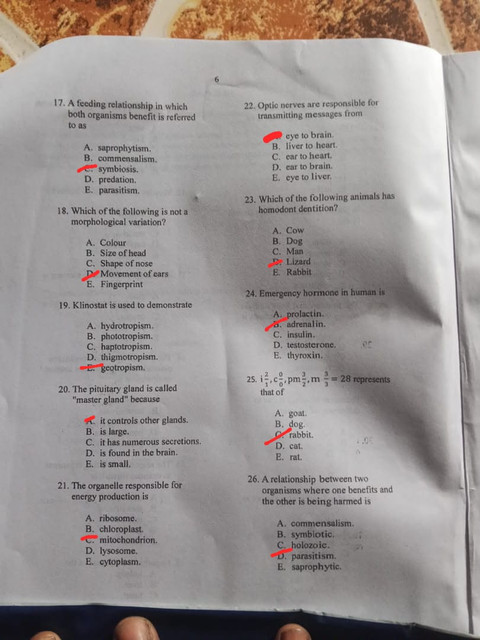


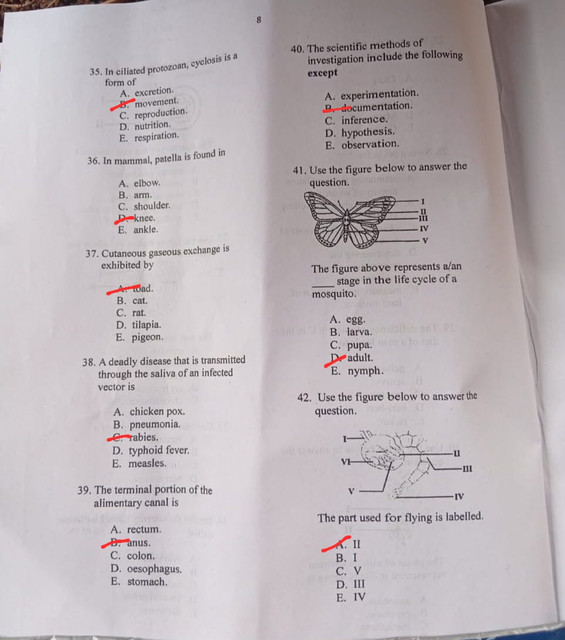

(1ai)
(PICK ANY ONE)
Tolerance is the ability of an organism to withstand or survive changes in environmental conditions within certain limits without being harmed.
OR
Tolerance is the range of environmental conditions within which an organism can survive, grow, and reproduce without being adversely affected.
(1aii)
(PICK ANY FOUR)
(i) Oxygen
(ii) Carbon dioxide
(iii) Digested food nutrients
(iv) Hormones
(v) Urea
(vi) Mineral salts.
(1b)
(i) Prophase
(ii) Metaphase
(iii) Anaphase
(iv) Telophase
(1c)
(PICK ANY FIVE)
(i) Division of labour: Termites live in organized colonies where each caste performs a specific role. The queen lays eggs, workers gather food and care for the young, while soldiers defend the colony. This cooperation ensures efficient use of resources, increases survival, and allows the colony to function successfully.
(ii) Nest building: Termites construct large mounds and underground nests using soil, saliva, and faeces. These nests provide protection from predators, rain, and extreme temperatures. The mound also helps regulate humidity and ventilation, creating a favourable environment for the colony throughout the year.
(iii) Nocturnal foraging: Termites usually search for food at night when temperatures are lower and predators are less active. This behaviour reduces water loss from their bodies and lowers the risk of being attacked. It enables them to gather enough food while remaining relatively safe.
(iv) Tunnel construction during feeding: Termites build covered mud tunnels from their nests to food sources. These tunnels protect them from sunlight, drying out, and predators such as ants and birds. They can move safely between the nest and feeding sites without being easily detected.
(v) Colony defence: Soldier termites guard the colony against invading predators. They use powerful jaws or release defensive chemicals to repel attackers. Their protective behaviour keeps the queen, workers, and developing young safe, ensuring the continued growth and survival of the entire colony.
(vi) Care of eggs and young: Worker termites constantly feed, clean, and protect the eggs, larvae, and queen. They move the young to suitable locations within the nest when necessary. This parental care increases the chances of successful development and helps maintain a healthy colony population.
(vii) Communication by pheromones: Termites communicate through chemical substances called pheromones. These signals help colony members locate food, warn of danger, identify nest mates, and coordinate activities. Effective communication promotes cooperation, reduces confusion, and improves the colony's ability to survive environmental challenges.
(viii) Mutual feeding: Termites feed one another by exchanging partially digested food through mouth-to-mouth or anus-to-mouth feeding. This behaviour distributes nutrients and beneficial microorganisms needed for cellulose digestion. It ensures that all members, especially the young and queen, receive adequate nourishment.
=============================
(2ai)
(PICK ANY FIVE)
(i) Kidney
(ii) Lungs
(iii) Skin
(iv) Liver
(v) Nephridia
(vi) Malpighian tubules
(vii) Contractile vacuole
(viii) Flame cells
(2aii)
(PICK ANY FIVE)
(i) Kidney – Human being
(ii) Lungs – Human being
(iii) Skin – Human being
(iv) Liver – Human being
(v) Nephridia – Earthworm
(vi) Malpighian tubules – Grasshopper
(vii) Contractile vacuole – Amoeba
(viii) Flame cells - Tapeworm
(2bi)
(PICK ANY TWO)
(i) Both remove metabolic waste products from the body.
(ii) Both regulate water balance.
(iii) Both help maintain salt (ion) balance.
(iv) Both excrete nitrogenous waste products.
(2bii)
(PICK ANY THREE)
(i) Earthworm has nephridia while mammals have kidneys.
(ii) Nephridia are found in almost every body segment while kidneys are only one pair.
(iii) Earthworm excretes wastes through nephridiopores while mammals excrete through the ureters, urinary bladder and urethra.
(iv) Earthworm mainly excretes ammonia while mammals mainly excrete urea.
(v) The excretory system of earthworm is simple while that of mammals is more complex.
(2c)
(PICK ANY ONE)
Stomata open when the guard cells absorb water by osmosis and become turgid. This causes the guard cells to curve outward and the stomatal pore opens. Potassium ions accumulate in the guard cells, lowering their water potential and drawing in more water.
When water leaves the guard cells by osmosis, they become flaccid. The guard cells straighten and the stomatal pore closes. This usually occurs at night or during water shortage, reducing water loss.
OR
The opening and closing of stomata depend on the turgidity of the guard cells. In the presence of light, guard cells accumulate potassium ions, absorb water and become turgid, causing the stomatal pore to open. In darkness or during water stress, potassium ions move out of the guard cells, water leaves by osmosis, the guard cells become flaccid and the stomatal pore closes.
============================
(3ai)
-Protein:
(PICK ANY TWO)
(i) Carbon
(ii) Hydrogen
(iii) Oxygen
(iv) Nitrogen
-Carbohydrate:
(PICK ANY TWO)
(i) Carbon
(ii) Hydrogen
(iii) Oxygen
(3aii)

(3aiii)
(PICK ANY TWO)
(i) Birth rate
(ii) Death rate
(iii) Immigration
(iv) Emigration
(v) Availability of food
(vi) Predation
(vii) Disease and parasites
(viii) Competition
(3bi)
(PICK ANY ONE)
Swarming is the gathering or movement of a large number of organisms of the same species together in one place, usually for breeding, feeding, migration, or protection.
OR
Swarming is the temporary congregation of a large number of organisms of the same species in one area for a specific purpose, such as breeding or migration.
(3bii)
(PICK ANY ONE)
Epidemic is the rapid spread of a disease that affects a large number of people in a particular community or region within a short period of time.
OR
Epidemic is the outbreak of an infectious disease that spreads rapidly and affects many people in a particular area at the same time.
(3ci)
(PICK ANY ONE)
Parthenocarpy is the development of a fruit from the ovary without fertilization of the ovules, resulting in a seedless fruit.
OR
Parthenocarpy is the process by which fruits develop from the ovary without pollination and fertilization, producing fruits that are usually seedless.
(3cii)
(PICK ANY TWO)
(i) Abstinence
(ii) Use of condom
(iii) Oral contraceptive pills
(iv) Intrauterine device
(v) Vasectomy
=============================
(4ai)
(PICK ANY THREE)
(i) Enzymes are proteins.
(ii) Enzymes are biological catalysts.
(iii) Enzymes are specific in their action.
(iv) Enzymes are not used up during chemical reactions.
(v) Enzymes are effective in small quantities.
(vi) Enzymes are affected by temperature.
(vii) Enzymes are affected by pH.
(viii) Enzymes speed up chemical reactions.
(4aii)
-Pupil:
(PICK ANY ONE)
The pupil regulates the amount of light entering the eye.
OR
The pupil allows light to pass into the eye.
-Conjunctiva:
(PICK ANY ONE)
The conjunctiva protects the front of the eye from dust and microorganisms.
OR
The conjunctiva secretes mucus which keeps the eye moist and lubricated.
-Cornea:
(PICK ANY ONE)
The cornea refracts light entering the eye to help focus images on the retina.
OR
The cornea protects the front part of the eye from injury and dust.
(4bi)

(4bii)
(i) Shoulder joint.
(ii) Hip joint.
(4c)

OR

=============================
(5ai)

(5aii)
(PICK ANY THREE)
(i) It has a large, thick centrum.
(ii) It has a short, broad and blunt neural spine.
(iii) It has long transverse processes.
(iv) It has a large vertebral canal.
(v) It has well developed articular processes for articulation with adjacent vertebrae.
(vi) It has no rib facets for articulation with ribs.
(5bi)
(i) Collenchyma
(ii) Sclerenchyma
(iii) Xylem
(5bii)
-Hemophilia:
(PICK ANY ONE)
Haemophilia is a hereditary blood disorder in which the blood fails to clot normally, causing excessive or prolonged bleeding even from minor injuries.
OR
Haemophilia is an inherited genetic disorder in which the blood lacks sufficient clotting factors, resulting in prolonged or excessive bleeding.
-Mutation:
(PICK ANY ONE)
Mutation is a sudden, permanent and heritable change in the genetic material (gene or chromosome) of an organism, which may result in a change in its characteristics.
OR
Mutation is a sudden change in the genes or chromosomes of an organism that can be inherited and may produce new characteristics or variations.
-Sex-linked character:
(PICK ANY ONE)
Sex-linked character is a characteristic controlled by a gene located on the sex chromosomes (usually the X chromosome) and inherited differently in males and females.
OR
Sex-linked character is a hereditary trait determined by genes carried on the sex chromosomes and transmitted from parents to their offspring according to sex.
(5ci)
(i) Subsistence farming
(ii) Commercial farming
(iii) Mixed farming
(5cii)
(PICK ANY TWO)
(i) Drying
(ii) Smoking
(iii) Salting
(iv) Refrigeration
(v) Freezing
(vi) Canning
 |
|
 |
|