2026 NABTEB ECONOMICS ANSWERS (TYPE A)
ECONOMICS TYPE A
01-10: CDCDCBDAAC
11-20: ABCBADBBBC
21-30: BCBBCCACAC
31-40: BCBBBACCBB
41-50: DBCBACDCAB
ECONOMICS OBJ (TYPE B)
01-10: BACDCABCBB
11-20: CCACACCBBD
21-30: BCACABCBAD
31-40: BBDCDCBDAC
41-50: CBBCBCBBBA
ECONOMICS OBJ (TYPE C)
01-10: ADBCDCDCDA
11-20: BCBACABBBC
21-30: BACCCBBCAB
31-40: BBCBCACBBD
41-50: BCCBADCCAB
ECONOMICS OBJ (TYPE D)
01-10: ABCBACABAC
11-20: DCABCCBBDB
21-30: CCDCDCBDAB
31-40: BBCBCBBCCA
41-50: CABBBCBCAD
=================
NOTE: In Theory, Type A, B, C & D are the same but reshuffled. Use the answers provided to trace the correct questions in your booklet before answering.
WE USED TYPE-A IN SOLVING, SO TRACE FROM YOUR QUESTIONS BEFORE COPYING THE ANSWERS.
PART I: ANSWER ONE(1) QUESTION ONLY
(1)
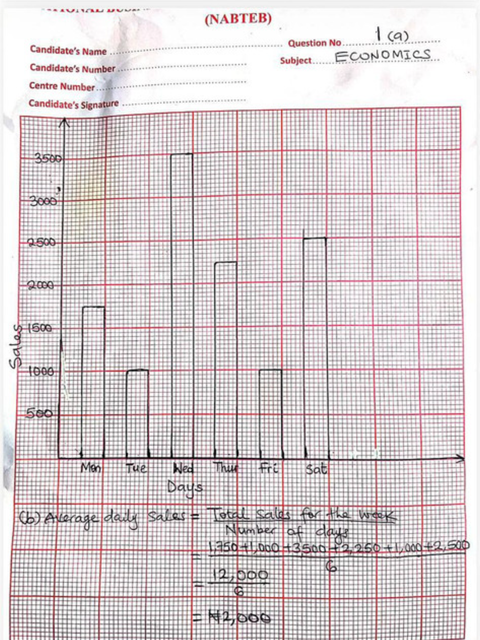
===================================
(2a)

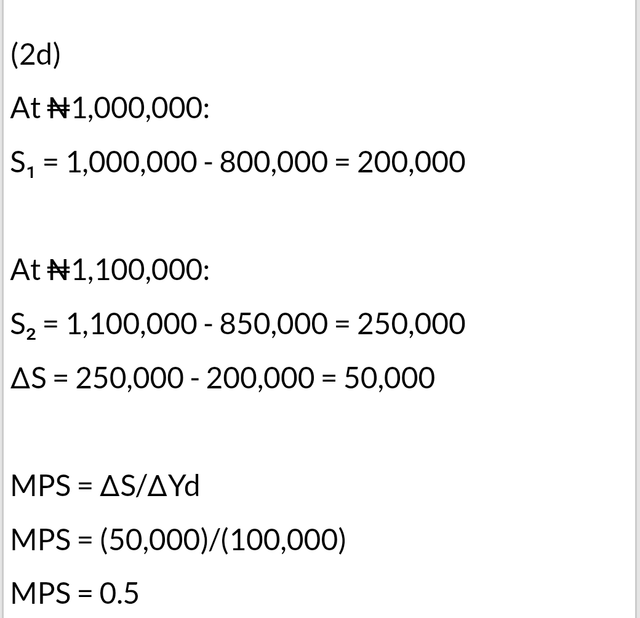
===================================
PART II: ANSWER FOUR(4) QUESTIONS ONLY
(3)
(i) Provision of modern farm inputs and subsidies: The government can boost agricultural output by making improved seeds, fertilizers, pesticides, herbicides, and machinery affordable and accessible to farmers. When these inputs are heavily subsidized or distributed at reduced prices, farmers are able to increase productivity per hectare. High-yield and disease-resistant seed varieties also help to reduce crop failure and improve overall national food supply.
(ii) Provision of credit facilities to farmers: Many Nigerian farmers operate on a small scale due to lack of capital. Government can improve production by providing low-interest loans, agricultural grants, and credit schemes through institutions such as agricultural banks and cooperatives. Easy access to finance enables farmers to expand farm size, adopt modern technology, hire labour, and invest in irrigation and storage facilities, all of which increase output.
(iii) Development of infrastructure in rural areas: Agricultural production improves when rural infrastructure is well developed. The government should provide good road networks to help farmers transport produce from farms to markets, reduce post-harvest losses, and lower transportation costs. In addition, electricity, irrigation systems, storage facilities (silos and warehouses), and water supply should be developed to support year-round farming and reduce dependence on seasonal rainfall.
(iv) Provision of extension services and farmer education: Agricultural extension services help to educate farmers on modern farming techniques such as crop rotation, mixed farming, pest control, and soil conservation. Government extension officers can demonstrate new technologies and provide technical advice to farmers. This improves farmers’ knowledge, increases efficiency, and encourages adoption of improved agricultural practices, leading to higher productivity.
(v) Investment in research and development (R&D): Government can enhance agricultural production by funding agricultural research institutes and universities to develop improved crop varieties and livestock breeds. Research into soil fertility, disease control, irrigation techniques, and climate-resilient farming helps farmers adapt to environmental challenges. When research findings are properly communicated to farmers, it leads to improved yields and sustainable agriculture.
===================================
(4)
(i) Private Sector: The private sector refers to the part of the economy that is owned, controlled, and managed by individuals or private organizations rather than the government. The main objective of private sector enterprises is profit maximization. Examples include private companies, sole proprietorships, partnerships, and corporations engaged in activities such as banking, manufacturing, and trading.
(ii) Public Sector: The public sector consists of all economic activities, enterprises, and services owned, controlled, and managed by the government. Its main aim is not profit but to provide essential services and promote social welfare. Examples include government ministries, public schools, public hospitals, and state-owned enterprises such as electricity and water corporations.
(iii) Market Economy: A market economy is an economic system in which decisions about production, pricing, and distribution of goods and services are determined by the forces of demand and supply with minimal government intervention. Resources are allocated through the price mechanism, and individuals are free to own property and engage in business activities.
(iv) Subsistence Economy: A subsistence economy is one in which production is mainly for personal consumption rather than for sale in the market. Most people engage in agriculture or simple production activities, and output is usually just enough to meet basic needs such as food, clothing, and shelter, with little or no surplus for trade.
(v) Mono-product Economy: A mono-product economy is an economy that depends heavily on a single major product or sector for its income and development. Such economies are highly vulnerable to price fluctuations and external shocks. For example, countries that rely mainly on crude oil exports or a single agricultural product fall into this category.
===================================
(5a)
(i) Total Cost (TC): Total cost is the total amount of money spent by a firm in producing a given level of output. It consists of both fixed and variable costs. Fixed costs remain constant regardless of output, such as rent and salaries, while variable costs change with output, such as raw materials and wages. Therefore, total cost increases as output increases. It is expressed as TC = TFC + TVC.
(ii) Average Cost (AC): Average cost is the cost per unit of output produced. It is calculated by dividing total cost by total output, that is AC = TC ÷ Q. It shows the cost efficiency of production per unit. It falls at first due to better use of fixed costs but later rises because of diminishing returns.
(iii) Marginal Cost (MC): Marginal cost is the extra cost incurred in producing one additional unit of output. It is calculated as MC = ?TC ÷ ?Q. It helps firms decide whether to increase or reduce production, depending on whether it is profitable.
(5b)
Accountants define cost mainly as explicit cost, meaning actual money payments made by the firm for inputs such as wages, rent, raw materials, and interest on loans. These costs are recorded in financial books and receipts.
Economists, however, take a broader view by including both explicit and implicit (opportunity) costs. Implicit costs refer to the value of resources owned and used by the entrepreneur, such as his own labour or capital, measured by what they could earn in their next best alternative use.
===================================
(6a)
Devaluation is the deliberate reduction in the value of a country’s currency in relation to foreign currencies by the government under a fixed exchange rate system. It means more units of the local currency are needed to obtain foreign currency, making exports cheaper and imports more expensive.
(6b)
(i) Export promotion: The government can encourage exports by giving subsidies to exporters, improving production quality, and supporting local industries. This increases foreign exchange earnings and helps reduce the deficit.
(ii) Import restriction: This involves reducing imports through tariffs, quotas, or bans on certain goods. It discourages excessive importation and encourages consumption of locally produced goods.
(iii) Devaluation of currency: By reducing the value of the local currency, exports become cheaper and more competitive abroad while imports become more expensive, thereby improving the balance of payments.
(iv) Encouragement of foreign investment: The government can attract foreign direct investment by providing incentives such as tax relief, stable policies, and good infrastructure, which increases inflow of foreign currency.
(v) Export diversification: This involves expanding the range of export products to reduce dependence on a single commodity, thereby stabilizing export earnings and improving the balance of payments position.
===================================
(7)
(i) Issue of Shares (Ordinary Share Capital): A public limited company can raise long-term finance by issuing ordinary shares to the public through the capital market. Shareholders buy these shares and become part owners of the company. This source provides permanent capital since it does not have to be repaid. However, shareholders are entitled to dividends when the company makes profits, and they also have voting rights in company decisions.
(ii) Issue of Debentures: Debentures are long-term loans raised by the company from the public at a fixed rate of interest. Unlike shareholders, debenture holders are not owners of the company but creditors. The company is obliged to pay interest whether it makes profit or not. This source is useful for financing expansion projects and large investments.
(iii) Retained Earnings (Ploughing Back of Profits): A company can finance its operations using profits that are not distributed as dividends but are retained in the business. This is called retained earnings.
It is a cheap and internal source of finance because it does not involve interest payment or issuing new shares, and it helps the company grow steadily.
(iv) Bank Loans and Overdrafts: Public limited companies can obtain short-term or medium-term finance from commercial banks. Loans are usually repaid over an agreed period with interest, while overdrafts allow the company to withdraw more than its account balance up to a limit. This source is useful for meeting working capital needs such as wages and raw materials.
(v) Public Issue (Stock Exchange/Further Issue of Shares): A public limited company can raise additional capital by offering new shares to the public through the stock exchange. This is often used when the company wants to expand operations or finance new projects. It increases the company’s capital base but may reduce the ownership control of existing shareholders due to dilution.
===================================
(8a)
Economic planning refers to a deliberate and systematic effort by the government to allocate the nation’s scarce resources in order to achieve specific economic objectives over a period of time. It involves setting targets for sectors such as agriculture, industry, education, and infrastructure, and coordinating policies to achieve growth, development, and improved welfare of citizens.
(8b)
(i) Inadequate funding: One major problem of development plans in Nigeria is inadequate funding. Government revenue is often insufficient due to overdependence on oil and low tax generation. As a result, many planned projects are either delayed, poorly executed, or completely abandoned because there is not enough money to finance them.
(ii) Political instability and policy inconsistency: Frequent changes in government and policies disrupt development planning in Nigeria. Each new administration often abandons or modifies existing plans, making long-term projects difficult to complete successfully.
(iii) Corruption and mismanagement: Corruption remains a serious obstacle to development planning. Funds allocated for projects are often diverted, inflated, or mismanaged, leading to poor implementation and low-quality infrastructure.
(iv) Poor implementation and administrative weakness: Even when good plans are made, weak administrative structures, lack of coordination among agencies, and shortage of skilled personnel reduce effective implementation of development plans.
(v) Inaccurate data and poor statistics: Development planning in Nigeria is also affected by lack of reliable and up-to-date data on population, resources, and economic activities. This leads to unrealistic targets and poor decision-making in planning.
 |
|
 |
|